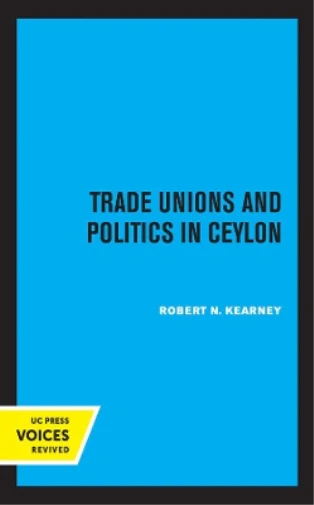
Trade Unions and Politics in Ceylon
Trade Unions and Politics in Ceylon offers the first sustained analysis of how a rapidly expanding labor movement helped shape—and was shaped by—the politics of a newly independent, modernizing society. Tracing trade union growth from the late colonial period through the first post-independence decade, Robert N. Kearney shows how Ceylon’s unions combined “economic” functions (wages, conditions, dispute resolution) with explicitly partisan roles that recruited, socialized, and mobilized workers for electoral politics. Against a backdrop of universal suffrage, an interventionist state, and extensive wage-setting and arbitration machinery, Kearney explains why unions gravitated toward party alliances and why leaders often pursued transformative political victories over incremental bargaining wins. The result is a finely grained portrait of organizations that were simultaneously fragmented and indispensable—organizationally weak yet among the few mass, voluntary associations articulating modern occupational interests.
Drawing on comparative theories of political development and rich institutional detail, Kearney maps the full spectrum of union–party relationships—distinguishing party-sponsored, party-oriented, and uncommitted unions—and shows how each type navigated strikes, industrial tribunals, Cabinet-centric governance, and a rule-bound bureaucracy. Case sketches illuminate the contrasting strategies of public-sector associations and private-sector unions; thematic chapters assess the political consequences of industrial conflict and the centripetal/centrifugal effects of partisanship on movement unity. This is essential reading for scholars of South Asian politics, labor history, and comparative development: it reframes Ceylon (Sri Lanka) as a key instance of how democratization, state intervention, and Marxist and non-Marxist party competition produced a distinctive style of trade unionism—deeply political, often polarized, and profoundly consequential for policy and participation. Kearney’s clear typology and comparative lens make the book an invaluable guide for understanding labor’s political role across postcolonial contexts.
This title is part of UC Press's Voices Revived program, which commemorates University of California Press’s mission to seek out and cultivate the brightest minds and give them voice, reach, and impact. Drawing on a backlist dating to 1893, Voices Revived makes high-quality, peer-reviewed scholarship accessible once again using print-on-demand technology. This title was originally published in 1971.
Original: $170.63
-70%$170.63
$51.19Product Information
Product Information
Shipping & Returns
Shipping & Returns
Description
Trade Unions and Politics in Ceylon offers the first sustained analysis of how a rapidly expanding labor movement helped shape—and was shaped by—the politics of a newly independent, modernizing society. Tracing trade union growth from the late colonial period through the first post-independence decade, Robert N. Kearney shows how Ceylon’s unions combined “economic” functions (wages, conditions, dispute resolution) with explicitly partisan roles that recruited, socialized, and mobilized workers for electoral politics. Against a backdrop of universal suffrage, an interventionist state, and extensive wage-setting and arbitration machinery, Kearney explains why unions gravitated toward party alliances and why leaders often pursued transformative political victories over incremental bargaining wins. The result is a finely grained portrait of organizations that were simultaneously fragmented and indispensable—organizationally weak yet among the few mass, voluntary associations articulating modern occupational interests.
Drawing on comparative theories of political development and rich institutional detail, Kearney maps the full spectrum of union–party relationships—distinguishing party-sponsored, party-oriented, and uncommitted unions—and shows how each type navigated strikes, industrial tribunals, Cabinet-centric governance, and a rule-bound bureaucracy. Case sketches illuminate the contrasting strategies of public-sector associations and private-sector unions; thematic chapters assess the political consequences of industrial conflict and the centripetal/centrifugal effects of partisanship on movement unity. This is essential reading for scholars of South Asian politics, labor history, and comparative development: it reframes Ceylon (Sri Lanka) as a key instance of how democratization, state intervention, and Marxist and non-Marxist party competition produced a distinctive style of trade unionism—deeply political, often polarized, and profoundly consequential for policy and participation. Kearney’s clear typology and comparative lens make the book an invaluable guide for understanding labor’s political role across postcolonial contexts.
This title is part of UC Press's Voices Revived program, which commemorates University of California Press’s mission to seek out and cultivate the brightest minds and give them voice, reach, and impact. Drawing on a backlist dating to 1893, Voices Revived makes high-quality, peer-reviewed scholarship accessible once again using print-on-demand technology. This title was originally published in 1971.