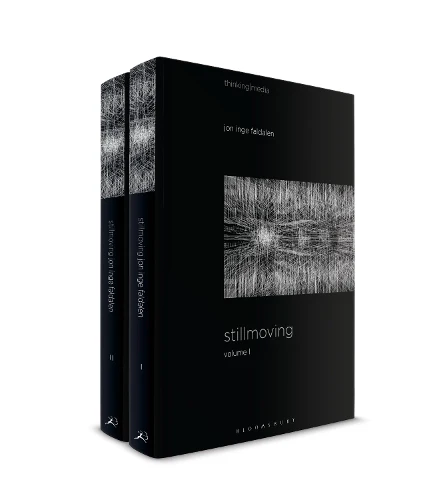
Stillmoving
A two-volume theoretical and conceptual contribution to cinema and media studies in general and slow cinema and still moving scholarship in particular, asking what kind of image a still Einstellung generates. This two-volume work explores a static long take, termed a still Einstellung, as well as coexistent still and moving imagery by Lumière, Welles and the MPEG compression codec, to contemplate the kind of image it generates.
Jon Inge Faldalen’s volumes are a theoretical exploration of the concept of Einstellung. The author keeps the original German term, capitalizing on the ambiguity inherent in this type of image phenomenon; in this case, the long take, or at least a continuous unbroken take, effected by an immobile camera whose captured content could potentially contain perceptible movements produced by entities within the composition framed. The author embraces neologisms in order to capture specific aesthetic-technical phenomena more accurately than has hitherto been possible.
Stillmoving I is a theoretical exploration of the concept of Einstellung. The author asks whether this image is a still image, or a moving image, or both, or neither, or, finally, what Faldalen terms stillmoving. Underlying these deliberations is the question of how cinema represents or mediates stillness. It unfolds over three chapters that examine the concept of still Einstellung in relation to slow cinema scholarship throughout the last two decades, in relation to approaches referred to as stillmoving scholarship, and in relation to reflections and shadows.
Stillmoving II continues the work of the first volume, exploring the concept of Einstellung through a small set of specific case studies, including Louis Lumière’s Quai de l’Archevêché (Lumière operator, 1896), André Bazin’s analysis of the kitchen scene in The Magnificent Ambersons (Orson Welles, 1942), and James Benning’s Stemple Pass (2012), as well as what the author calls “digital imagenesis,” which concerns the MPEG compression codec.
Product Information
Product Information
Shipping & Returns
Shipping & Returns
Description
A two-volume theoretical and conceptual contribution to cinema and media studies in general and slow cinema and still moving scholarship in particular, asking what kind of image a still Einstellung generates. This two-volume work explores a static long take, termed a still Einstellung, as well as coexistent still and moving imagery by Lumière, Welles and the MPEG compression codec, to contemplate the kind of image it generates.
Jon Inge Faldalen’s volumes are a theoretical exploration of the concept of Einstellung. The author keeps the original German term, capitalizing on the ambiguity inherent in this type of image phenomenon; in this case, the long take, or at least a continuous unbroken take, effected by an immobile camera whose captured content could potentially contain perceptible movements produced by entities within the composition framed. The author embraces neologisms in order to capture specific aesthetic-technical phenomena more accurately than has hitherto been possible.
Stillmoving I is a theoretical exploration of the concept of Einstellung. The author asks whether this image is a still image, or a moving image, or both, or neither, or, finally, what Faldalen terms stillmoving. Underlying these deliberations is the question of how cinema represents or mediates stillness. It unfolds over three chapters that examine the concept of still Einstellung in relation to slow cinema scholarship throughout the last two decades, in relation to approaches referred to as stillmoving scholarship, and in relation to reflections and shadows.
Stillmoving II continues the work of the first volume, exploring the concept of Einstellung through a small set of specific case studies, including Louis Lumière’s Quai de l’Archevêché (Lumière operator, 1896), André Bazin’s analysis of the kitchen scene in The Magnificent Ambersons (Orson Welles, 1942), and James Benning’s Stemple Pass (2012), as well as what the author calls “digital imagenesis,” which concerns the MPEG compression codec.